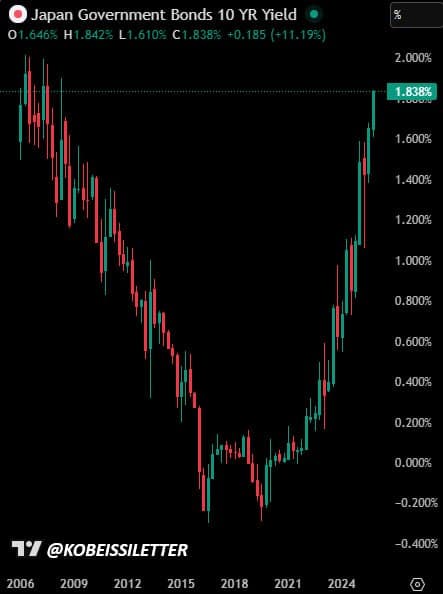
Japan"s 10-Year Government Bond Yield Reaches Highest Level Since 2008
On December 1, 2025, Japan"s 10-year government bond yield surged to 1.84%, marking its highest level since April 2008. This increase signifies a substantial rise in borrowing costs for the Japanese government, which has maintained near-zero interest rates for an extended period. The recent spike in yields is a reflection of changing economic conditions, including rising inflation and shifts in government fiscal policy.
Key Details
Japan"s 10-year government bond yield, which is a critical indicator of the country"s borrowing costs, has jumped to approximately 1.84%. This figure represents a significant increase from the historically low levels that have characterized Japan"s bond market for nearly two decades. The central bank"s previous policy of purchasing large quantities of government bonds effectively kept yields suppressed, but recent economic developments have prompted a reevaluation of this approach.
One of the primary factors contributing to the rise in bond yields is the increase in inflation, which currently stands at 3%. As inflation rises, investors demand higher yields to compensate for the decreased purchasing power of future interest payments. Additionally, the Japanese government is planning a substantial debt-funded spending package, which has raised concerns among investors regarding fiscal discipline and the sustainability of Japan"s debt levels.
As investor confidence wanes, bond prices have fallen, leading to higher yields. This dynamic creates a challenging environment for the Japanese government, which will face increased interest expenses on its already significant debt burden. The implications of rising yields extend beyond government finances; they also affect banks and insurance companies that hold these bonds, which may experience mark-to-market losses as bond prices decline.
The rise in yields is expected to have a cascading effect on the broader economy, as borrowing costs for mortgages, business loans, and other forms of credit are likely to increase over time. Higher yields can also impact consumer spending and investment, potentially slowing economic growth.
Global Implications
Japan is a major player in global bond markets, and its historically low yields have facilitated carry trades, where investors borrow in yen to invest in higher-yielding foreign assets. As Japanese yields rise, there is a possibility that some of this capital will be repatriated, which could exert pressure on other bond markets and risk assets worldwide. The interconnectedness of global financial markets means that changes in Japan"s bond yields can have far-reaching consequences.
Background
For years, Japan has operated under a monetary policy framework characterized by ultra-low interest rates, a strategy aimed at stimulating economic growth and combating deflation. The Bank of Japan has played a crucial role in this environment by purchasing government bonds to maintain low yields. However, as inflationary pressures have emerged, the central bank is gradually stepping back from its aggressive bond-buying program, leading to the current rise in yields.
What"s Next
With the current inflation rate at 3% and the 10-year bond yield at 1.84%, there is potential for yields to increase further. Investors will be closely monitoring the government"s fiscal policies and the central bank"s response to inflation as they assess the future trajectory of bond yields. The situation underscores the delicate balance that Japan must maintain between stimulating economic growth and managing its substantial debt levels.
As previously reported, the implications of rising yields are not confined to Japan alone; they resonate throughout the global financial landscape, affecting investment strategies and economic conditions in other countries. For more on related coverage, see our article on recent developments in economic conditions across the globe.



![[Video] Gunfire between Iraqi security forces and Sadr militias in Baghdad](/_next/image?url=%2Fapi%2Fimage%2Fthumbnails%2Fthumbnail-1768343508874-4redb-thumbnail.jpg&w=3840&q=75)