Russia"s SVR Labels Ecumenical Patriarch Bartholomew I as "Antichrist"
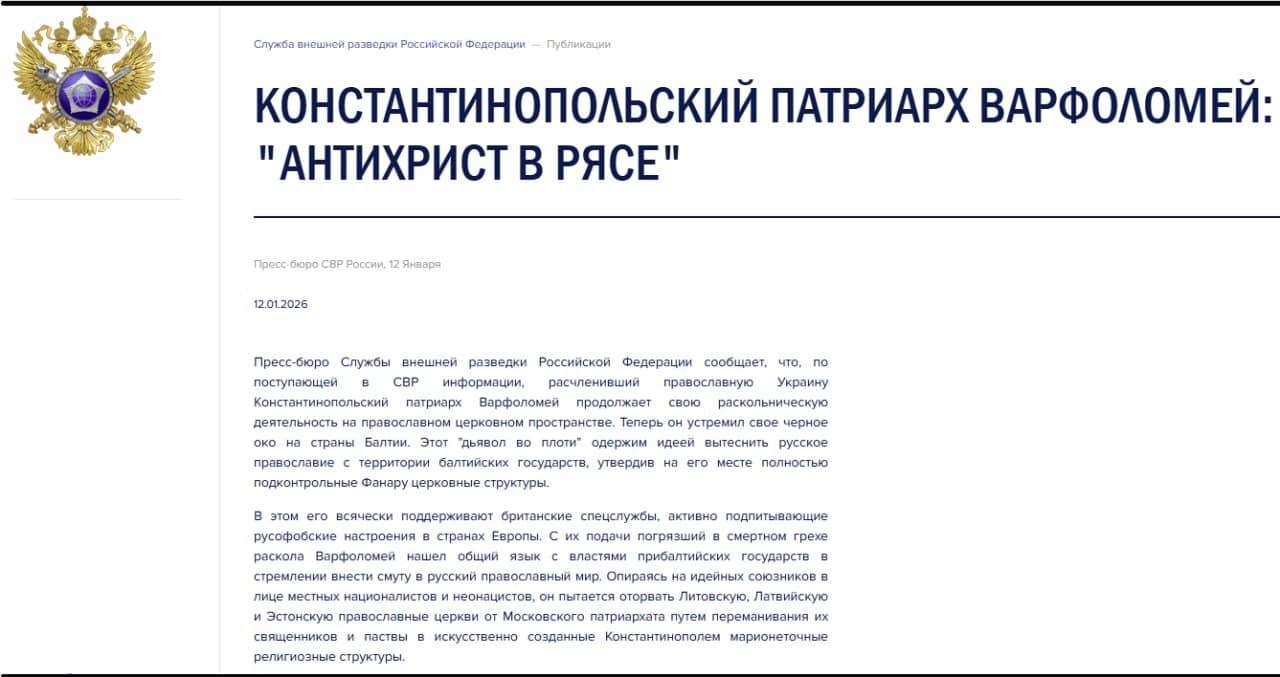
In a provocative statement, Russia"s Foreign Intelligence Service (SVR) has branded Ecumenical Patriarch Bartholomew I of Constantinople as the "Antichrist in a Cossack." This declaration, made public on January 12, 2026, highlights the ongoing tensions between the Russian Orthodox Church and the Ecumenical Patriarchate, particularly in the context of geopolitical and religious disputes in Eastern Europe.
Key Details
The SVR has accused Patriarch Bartholomew I of engaging in "schismatic" activities that have previously targeted the Orthodox Christian community in Ukraine. The agency claims that these actions are now extending to the Baltic states, specifically Lithuania, Latvia, and Estonia. The aim, according to the SVR, is to replace the existing Russian Orthodox Church structures in these countries with those that are loyal to the Ecumenical Patriarchate, often referred to as the Phanar.
In its statement, the SVR further alleges that British intelligence is actively supporting these efforts to undermine Russian Orthodoxy. The agency described Patriarch Bartholomew I in stark terms, labeling him a "devil in the flesh" who is fixated on destabilizing the Russian Orthodox Church.
Additionally, the SVR claims that there are plans to grant autocephaly, or independence, to the unrecognized Montenegrin Orthodox Church. This move is viewed as a strategy to weaken the influence of the Serbian Orthodox Church, which has historically been a significant player in the region.
Background
The Ecumenical Patriarchate, based in Istanbul, Turkey, is one of the oldest and most significant institutions in Eastern Orthodox Christianity. Patriarch Bartholomew I, who has held the position since 1991, has been a controversial figure, particularly in light of the 2018 decision to grant autocephaly to the Orthodox Church of Ukraine. This decision was met with strong opposition from the Russian Orthodox Church, which views Ukraine as part of its canonical territory.
The tensions between the Russian Orthodox Church and the Ecumenical Patriarchate have been exacerbated by broader geopolitical conflicts, including Russia"s annexation of Crimea in 2014 and its ongoing military involvement in Ukraine. These events have led to a significant rift within the Orthodox Christian community, with various national churches aligning themselves with either Moscow or Constantinople.
What"s Next
The SVR"s statement is likely to escalate the already heightened tensions between the Russian Orthodox Church and the Ecumenical Patriarchate. As the situation develops, it remains to be seen how the Orthodox communities in the Baltic states will respond to these accusations and whether further actions will be taken by either side to assert their influence in the region.
In light of these developments, observers will be closely monitoring the role of British intelligence in this religious and geopolitical conflict, as well as the potential implications for the Serbian Orthodox Church in Montenegro. The ongoing struggle for influence among Orthodox Christian communities in Eastern Europe is set to continue, with significant ramifications for regional stability and inter-church relations.
For further context on related geopolitical issues, see our coverage on recent developments regarding political tensions in the UK and their implications.


![[Video] Pope Leo XIV condemns anti-Christian violence in Nigeria, Bangladesh, and Damascus](/_next/image?url=%2Fapi%2Fimage%2Fthumbnails%2Fthumbnail-1768006244320-mmtpte-thumbnail.jpg&w=3840&q=75)


![[Video] Gunfire between Iraqi security forces and Sadr militias in Baghdad](/_next/image?url=%2Fapi%2Fimage%2Fthumbnails%2Fthumbnail-1768343508874-4redb-thumbnail.jpg&w=3840&q=75)