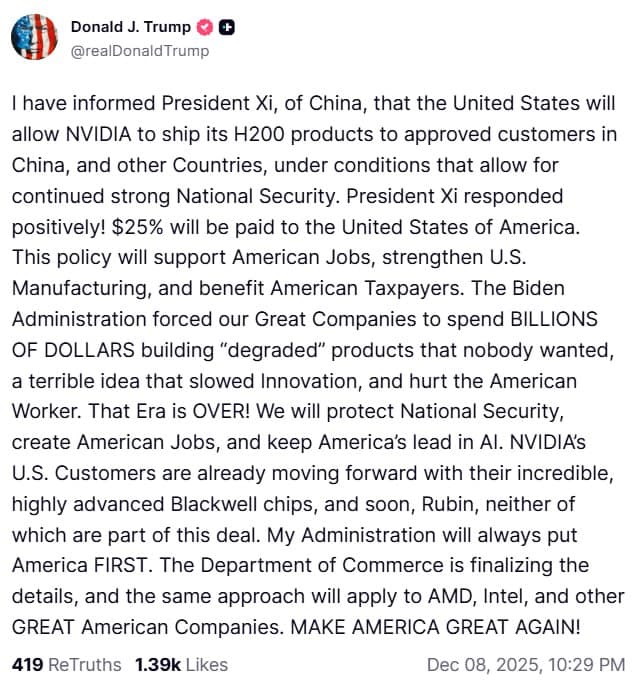
Trump Authorizes NVIDIA to Sell H200 Chips to Approved Customers in China
On December 8, 2025, President Donald Trump announced a significant policy shift regarding the sale of advanced technology products to China. The President has authorized NVIDIA Corporation, a leading American technology company, to ship its H200 chips to approved customers in China. This decision comes after direct communication with Chinese President Xi Jinping, who reportedly responded positively to the news. The arrangement is designed to ensure that national security remains a priority while facilitating trade between the two nations.
Key Details
In a statement regarding the authorization, President Trump indicated that he had informed President Xi about the decision to allow NVIDIA to export its H200 products. These chips are part of NVIDIA"s advanced computing technology, which is critical for various applications, including artificial intelligence and data processing. The authorization is contingent upon strict conditions that aim to maintain robust national security measures.
As part of the agreement, it has been reported that a fee of 25% will be paid to the United States for these transactions. This fee represents a significant revenue stream for the U.S. government, reflecting the ongoing negotiations and economic interactions between the two countries. The Department of Commerce is currently finalizing the details of this arrangement, ensuring compliance with U.S. regulations and security protocols.
Furthermore, this policy is not limited to NVIDIA alone. The same approach is expected to extend to other major American technology companies, including Advanced Micro Devices (AMD) and Intel Corporation. This broadens the scope of the initiative, potentially allowing a wider range of technological products to be exported to China under similar conditions.
Background
The decision to allow the sale of H200 chips to China comes amid a complex backdrop of U.S.-China relations, particularly in the technology sector. Over the past few years, the U.S. government has implemented various restrictions on technology exports to China, citing national security concerns. These restrictions have been part of a broader strategy to limit China"s access to advanced technologies that could enhance its military capabilities or economic competitiveness.
In recent months, there have been discussions about the need for a balanced approach that allows for economic cooperation while safeguarding national interests. The authorization of NVIDIA"s H200 chips may signal a shift towards a more nuanced policy that seeks to foster trade relations without compromising security.
What"s Next
The implications of this decision are significant for both the U.S. and China. For NVIDIA and other American technology firms, the ability to export advanced chips to China could open new markets and revenue opportunities. However, the ongoing scrutiny of technology exports will likely continue, with the Department of Commerce playing a crucial role in overseeing these transactions to ensure compliance with national security standards.
As previously reported, the U.S. government has been vigilant in monitoring technology transfers to China, and this new policy will likely be subject to close examination. The outcome of this initiative could set a precedent for future trade agreements and the overall relationship between the two economic powerhouses.
For more on related developments, see recent developments regarding President Trump"s stance on international trade and technology.

![[Video] Heavy clashes and gunfire reported in Baghdad, Iraq](/_next/image?url=%2Fapi%2Fimage%2Fthumbnails%2Fthumbnail-1768342239932-848qsh-thumbnail.jpg&w=3840&q=75)


![[Video] Gunfire between Iraqi security forces and Sadr militias in Baghdad](/_next/image?url=%2Fapi%2Fimage%2Fthumbnails%2Fthumbnail-1768343508874-4redb-thumbnail.jpg&w=3840&q=75)